

Proton DREAMS: Proton-driven molecular machines
Turning tautomeric molecular switches into nanoscale molecular motors
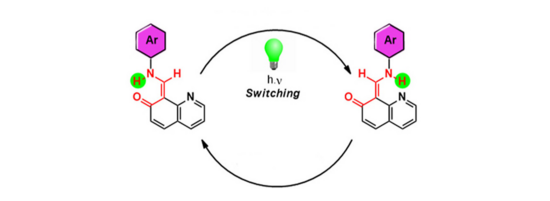
This international and multidisciplinary research project will develop nanoscale molecular motors that are powered by light energy and based on a chemical transformation called tautomerism: the concerted movement of hydrogen atoms within molecules. This approach has the potential to deliver particularly durable and fast molecular switches that could pave the way for novel nanotechnologies, such as light-responsive materials and targeted drug-delivery systems. To design, synthesize, and demonstrate the controlled rotation of the first tautomeric molecular motor, research teams from Bulgaria, Romania, and Switzerland will combine their leading expertise in theoretical molecular design, organic synthesis, and analytical laser spectroscopy within a highly collaborative research strategy.
Molecular motors are envisaged as the fundamental building blocks of functional machines on the nanoscale: single molecules capable of well-defined, uni-directional conformational motions, which are controlled by external stimuli such as light, pH, and oxidation/reduction reactions. Importantly, uni-directional switching can be achieved via molecular chirality, which introduces a directional bias in the associated conformational dynamics.
However, tailoring their switching behaviour to the demands of promising applications such as responsive nanomaterials or targeted drug delivery, requires the development of bespoke motor architectures that are highly robust, scalable, and energy-efficient. Towards this goal, our research consortium will develop a new type of molecular motor, based on a proto-driven switching mechanism, called tautomerism, which has thus far remained underexplored in motor designs, despite its favorable switching dynamics.
To achieve this, we are combining the complementary expertise of three academic research teams: 1) high-level modelling and design of high-performance tautomeric switches (Prof. L. Antonov, Bulgarian Academy of Sciences), 2) advanced asymmetric organic synthesis to introduce molecular chirality to the target designs (Prof. M. Matache, University of Bucharest), and 3) state-of-the-art ultrafast and chiral spectroscopy to determine the switching dynamics and to demonstrate uni-directional motion (Prof. M. Oppermann, University of Basel). Through this interdisciplinary approach, we aim to deliver the first proton-driven molecular motor, whose switching mechanism promises fast rotation speeds, exceptional fatigue resistance and reliable remote switching control via light irradiation.
Funding from the SNSF MAPS program
The Multilateral Academic Projects (MAPS) program (website) by the Swiss National Science Foundation (SNSF) is a multilateral initiative that supports collaborative research projects between researchers in Switzerland and their colleagues in Bulgaria, Croatia, Hungary, Poland and Romania. In the 2024 call, 29 proposals out of 334 submissions were funded with a total of 29.1 M CHF. The Proton DREAMS project was one of them and received approximately 1 M CHF from the SNSF with contributions from the Bulgarian Ministry of Education and Science, and the Executive Agency for Higher Education, Research, Development and Innovation Funding, Romania.